Training Room 2
1. Training Room 2
1.6. Page 7
Training Room 2: Inside Out—How the Body Works
© CLIPAREA.com/47213817/Fotolia,
© CLIPAREA.com/45256135/Fotolia
Landmarking
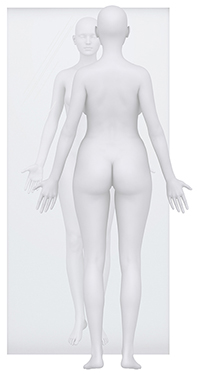
To describe the location of structures in the body and the direction of movement, a point of reference is used. This point of reference is called anatomical position. If you stand in front of a mirror with your hands at your sides and the palms of your hands facing the mirror, you are in anatomical position.

Using anatomical position as a starting point, common directional terms are used to describe the location of body structures. Pair up with a partner and take turns describing body parts in relation other body parts. Example: Your mouth is inferior to your nose.
Here are a few body parts to get you started:
- eyes
- toes
- hip bones
- spine
- intestines
- brain
Planes in the Body

adapted from: © Steve Young/18171610/Fotolia
The structure of the body can also be described using planes—imaginary flat surfaces that run through the body and divide the body into sections. Planes are used to describe direction of movement.
- The sagittal, or median, plane runs vertically through the middle of the body, dividing it into right and left halves.
- The frontal, or coronal, plane runs vertically and divides the body into front (anterior) and back (posterior) halves.
- The horizontal, or transverse, plane runs horizontally and divides the body into upper (superior) and lower (inferior) halves.
Watch “Anatomical Planes and Spatial Relationships in the Human Body” and explore “Planes of the Body.”
Now test your knowledge by completing Describing Location Self-Check.
Types of Movement and Joint Actions
The movement created when muscles pull on bones can be described in several ways. Practise naming and describing movement in Francine Moves.

Ryan McVay/Lifesize/Thinkstock
Complete Move Your Body. You will need a big mirror where you can see yourself move.
 Save your completed document in your course folder.