Training Room 4
| Site: | MoodleHUB.ca 🍁 |
| Course: | HSS1010: Health Service Foundations |
| Book: | Training Room 4 |
| Printed by: | Guest user |
| Date: | Friday, 19 December 2025, 1:29 AM |
Description
Created by IMSreader
1. Training Room 4
Training Room 4: Public Health
Introduction

Ryan McVay/Lifesize/Thinkstock
What are the roles, rights, and responsibilities for wellness shared between the individual and society?
Public health addresses the health needs of communities and individuals. Two levels of government, provincial and federal, work together to provide public health. The primary focus is on prevention and population health needs rather than individual health needs.

The role of the Public Health Agency of Canada is to
- promote health
- prevent and control chronic diseases and injuries
- prevent and control infectious diseases
- prepare for and respond to public health emergencies
- serve as a central point for sharing Canada’s expertise with the rest of the world
- apply international research and development to Canada’s public health programs
- strengthen intergovernmental collaboration on public health and facilitate national approaches to public health policy and planning
Public Health Agency of Canada
For more information, visit the Public Health Agency of Canada website.
In Training Room 4 you will study the following topics:
- Who Is Responsible for Your Health?
- Determinants of Health
- The Language of Health and Wellness
In Training Room 4 Project you will research and present the causes, treatment, and prevention of a disease or condition of your choice. You will bring together your discoveries from this course and examine how public health serves individuals.
Outcomes
Training Room 4 addresses the following outcomes:
- Describe the 12 key determinants of health as defined by Health Canada.
- Summarize the shared roles and responsibilities of individuals, community, and government involved with health care.
- Define terms related to wellness.
Focus
Keep these guiding questions in mind as you work through Training Room 4:
- How does disease occur?
- How can disease be prevented?
- What are the responsibilities shared between the individual and society to prevent and treat disease?
1.1. Page 2
Training Room 4: Public Health

Photos.com/Thinkstock
Who Is Responsible for Your Health?
Canada’s health care system provides universal coverage for medically necessary health care services through a partnership between the federal government and each of the provinces and territories.
Health Canada’s responsibilities include
- setting and administering national principles for the health care system through the Canada Health Act
- delivering health care services to specific groups—for example, First Nations and Inuit people
- partnering with each province and territory to plan and develop initiatives around health care human resource planning, medical technologies, and the delivery of primary health care
For more information, search using the term “Health Canada: Health Care System.”
In Alberta the provincial health ministry is Alberta Health. The responsibilities of Alberta Health include
- administration and delivery of health-care services using transfer funds from Health Canada
- issuing health care cards and administering the Alberta Health Care Insurance Plan
- planning and delivering health support and services to more than 3.7 million adults and children living in Alberta through Alberta Health Services
This health care flow chart gives an overview of the various levels of service provided and who covers the costs.
1.2. Page 3
Training Room 4: Public Health
Determinants of Health
Do you remember the 12 determinants of health from Training Room 1? The Public Health Agency of Canada ranks these key determinants according to their impact on health and wellness.
Social and Cultural Effects on Health and Wellness
Search the Internet using the term “Public Health Agency of Canada determinants of health.” Look for information on
- gender
- physical environments
- income and social status
- personal health practices and coping skills
Then compare the Public Health Agency descriptions to the World Health Organization’s Determinants of Health.

clockwise from top left: iStockphoto/Thinkstock, George Doyle/Stockbyte/Thinkstock, iStockphoto/Thinkstock, Jupiterimages/Photos.com/Thinkstock, Hemera/Thinkstock, Jupiterimages/Comstock/Thinkstock

After reading and comparing the two sets of determinants, consider the following questions:
- What effect does gender have on health and wellness? Is there a connection between health and wellness and gender, income, and social status?
- Which determinants would have an impact on someone with a disability? How?
- How would geography or physical environment affect health and wellness? Are there parts of Canada where health and wellness might be negatively affected by location?
- Why would it be important for an individual to take charge of his or her health and wellness and make choices such as practising cleanliness, attending regular medical and dental checkups, and taking personal responsibility to maximize health and wellness through diet and an active lifestyle?
Share your findings with a friend, family member, or classmate. Then post your answers to these questions in the course discussion area assigned by your teacher. You might use the heading “Social and Cultural Determinants.”
1.3. Page 4
Training Room 4: Public Health
The Language of Health and Wellness
Comstock/Thinkstock
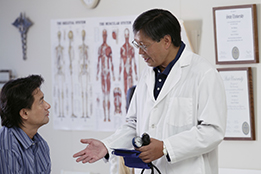
Education and access to health care are two of the determinants of health and wellness. In order to be well-informed consumers of health and wellness, it is important to understand some health care terminology. Get started by using Health-Care Terminology.

Hemera Technologies/AbleStock.com/Thinkstock
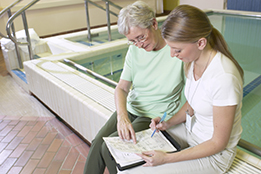
When someone in your family feels ill, how does the individual treat the situation? Does the person access any kind of treatment? What kinds? Would the person take medicine? Would she or he see a doctor or other health practitioner?
Reflect on the influences that have formed your approach to health and wellness. How great an impact does your family, your culture, your religion, your friends, where you live, and your economic and social status have on your approaches to health and wellness? Which factor has the most influence?
Discuss your findings with a friend, family member, or classmate. Add your comments to a course discussion of social and cultural determinants assigned by your teacher. You might use the heading “Personal Determinants.”
Medical Speak
Have you ever heard someone describing a medical condition or treatment with words that sounded like a foreign language? It might help your understanding to know a few common medical prefixes and suffixes.
Prefix (descriptors that come at the beginning of a word) |
Meaning | Examples |
| a | absent, deficient, lack of | atrophy: occurs when a tissue gets smaller |
| adipo | fat | adipose tissue: body fat |
| bronchi | refers to the air passages in the lungs | bronchitis: inflammation of the air passages |
| cephal | head | hydrocephalus: a condition with excess fluid in the brain |
| ecto | outside or external | ectocornea: the external layer of the cornea |
| endo | within or internal | endometrium: the inner lining of the uterus |
| epi | on, upon, at outer, covering | epidermis: outer layer of skin |
| hetero | different, other | One X and one Y chromosome constitute a heteromorphic pair. |
| homo | same | Two X chromosomes constitute a homomorphic pair. |
| hydro | water | hydrotherapy: the therapeutic use of water (as in a whirlpool bath) |
| intra | inside, within | intramuscular injection: an injection given into the muscle |
| inter | between | interstitial fluid: fluid between cells |
| infra | below | infraspinatus muscle: muscle that originates below the muscle of the scapula |
| lipo | fat | liposuction: a procedure to remove fat cells |
| macro | large | macroscopic: large enough to be observed by the naked eye |
| micro | small | microscopic: so small as to be invisible without the use of a microscope |
| morph | form or structure | morphology: the study of the form and structure of organisms |
| myo | muscle | myopathies: neuromuscular disorders in which the primary symptom is muscle weakness |
| neuro | nerve | neuromuscular disorders: disorders that result from a breakdown of the nervous system causing deterioration of the muscle |
| osteo | bone | osteoarthritis: a condition of the bones that causes pain in the joints |
| peri | around | pericardium: covering around the heart |
| pneumo | air | pneumothorax: occurs when there is a puncture in the cavity around the lungs |
Suffix (descriptors that come at the end of a word) |
Meaning | Examples |
| cyte | cell | monocyte: a large white blood cell |
| cide | destroy | spermicides: substances used to kill sperm |
| itis | inflammation | arthritis: an inflammation of a joint |
| ology | study of something | biology: the study of life |
| osis | a state or condition, usually indicates an increase in the condition | prognosis: the predicted course of a disease |
| stomy | surgical opening | colostomy: the opening of the colon for surgery |
| plasty | reconstruction | rhinoplasty: the reconstruction of the nose |


iStockphoto/Thinkstock
Can you think of other examples of common medical prefixes and suffixes that you have heard? You can use MedlinePlus to determine word parts and their meanings.
Post two or three examples of medical words and their breakdown in the course discussion area assigned by your teacher. You might use the heading “Medical Terms.”
Compare your examples with those of your classmates.
1.4. Page 5
Training Room 4: Public Health
Training Room 4 Summary
Hemera/Thinkstock
You investigated the public health system in Canada and defined terminology related to health and wellness. In Training Room 4 Project you will research the causes, treatment, and prevention of a disease or condition of your choice.
1.5. Project
Training Room 4: Public Health
Project
In Training Room 4 Project you will consider how public health serves individuals. Your  project is to research the causes, treatment, and prevention of a disease or condition of your choice. The disease or condition you choose should be major, such as diabetes, AIDS, or a particular form of cancer. Check with your teacher once you have chosen a disease or condition to make sure it meets the requirements for this project.
You will submit two pieces to your teacher for assessment:
- a presentation that discusses the causes, treatment, and prevention of a disease or condition of your choice
- responses to the Formative Self-Assessment Reflection Questions
Ready to try a new presentation format? Your presentation can take any form that you and your teacher agree upon, but you might want to try a format you haven’t used yet in this course. For example, you might present your content in the form of a magazine article, an interview, or a newscast. Whatever format you choose, ensure that your presentation includes all required information and references.
Suggested Time
Project Skill Level: intermediate
Estimated Time: 6 to 8 hours
Materials
You will need the following:
- access to the Internet or a library to conduct your research
- software and equipment to prepare your presentation
Assessment
Your teacher will use the Training Room Project Rubric to assess the extent to which you have
- followed the directions given for the project
- collected, analyzed, and interpreted information appropriately with supporting details
- organized information in an appropriate way
- communicated ideas clearly and correctly, including citing references
- presented your ideas in a clear and appealing format
Real World
Many Canadians take pride in the Canadian health-care system when compared to other countries around the world. With an aging population, there are increased pressures on the system and increased costs associated with the system. Gaining a greater awareness of preventable diseases and taking steps to minimize the chances of developing these diseases is one way to lessen the stress on the public health-care system.
Instructions
Step 1: Work through Training Room 4.
Step 2: Choose a major disease or condition on which to base your research; for example, diabetes, AIDS, a particular form of cancer, or a major surgery, such as heart surgery or knee or hip replacement. Confirm the topic with your teacher before getting to work.
Step 3: Research the disease or condition you have chosen, making sure to keep track of all your sources of information. Make sure you answer these questions:
- What are the causes of the condition or disease?
- What determinants of health might play a role in the occurrence of the condition or disease?
- What body systems are affected by the disease or condition? Is the disease one that grows from the cellular level? Does the disease or condition affect the whole body or only one organ?
- What is the treatment for the disease or condition? Include mainstream medical treatments as well as alternative or complementary therapies.
- How transferable is the disease or condition? Consider all levels of transfer, including genetic and person-to-person. How can the disease be contained?
- How can the disease or condition be prevented? Include mainstream medical treatments, such as vaccinations, but also consider alternative or complementary options.
- What roles do physical activity and healthy lifestyle choices play in preventing this disease or condition? Can physical activity and healthy lifestyle choices play a role in the treatment?
- Who pays for treatment of the disease or condition? What levels of health care are involved—federal, provincial, local? What are the implications for someone who does not have medical insurance coverage other than what is provided by the government?
- What are the rates of occurrence of the disease or condition in Alberta and Canada? What is the prognosis for someone who is affected by the disease or condition?
Step 4: Compile all your information into an appropriate, visually appealing, well-organized, and easy-to-read format. Edit your presentation for matters of correctness, such as spelling, grammar, and punctuation.
Step 5: Respond to the Formative Self-Assessment Reflection Questions. Save your responses in your project subfolder. Name the file “TRR5_Self_Reflections.”
Step 6: Submit your presentation and reflection to your teacher for assessment.